

For safety officers, HR managers, and fleet owners, the landscape of drug and alcohol testing is a minefield of regulatory requirements and administrative burdens. Managing a compliant program internally is a high-stakes gamble, where a single misstep can lead to crippling fines, legal liability, and operational shutdowns. Discover how a Third-Party Administrator (TPA) for drug testing, particularly a Consortium/Third-Party Administrator (C/TPA) for DOT-regulated businesses, secures your regulatory standing and eliminates this overwhelming burden.
A professional TPA is not merely a vendor; it is an employer's primary defense against regulatory failure. This guide explains the comprehensive role of a TPA, contrasts internal management with expert outsourcing, and details the core functions that ensure your company remains audit-proof and secure.
What is a Third Party Administrator (TPA) for Drug Testing?
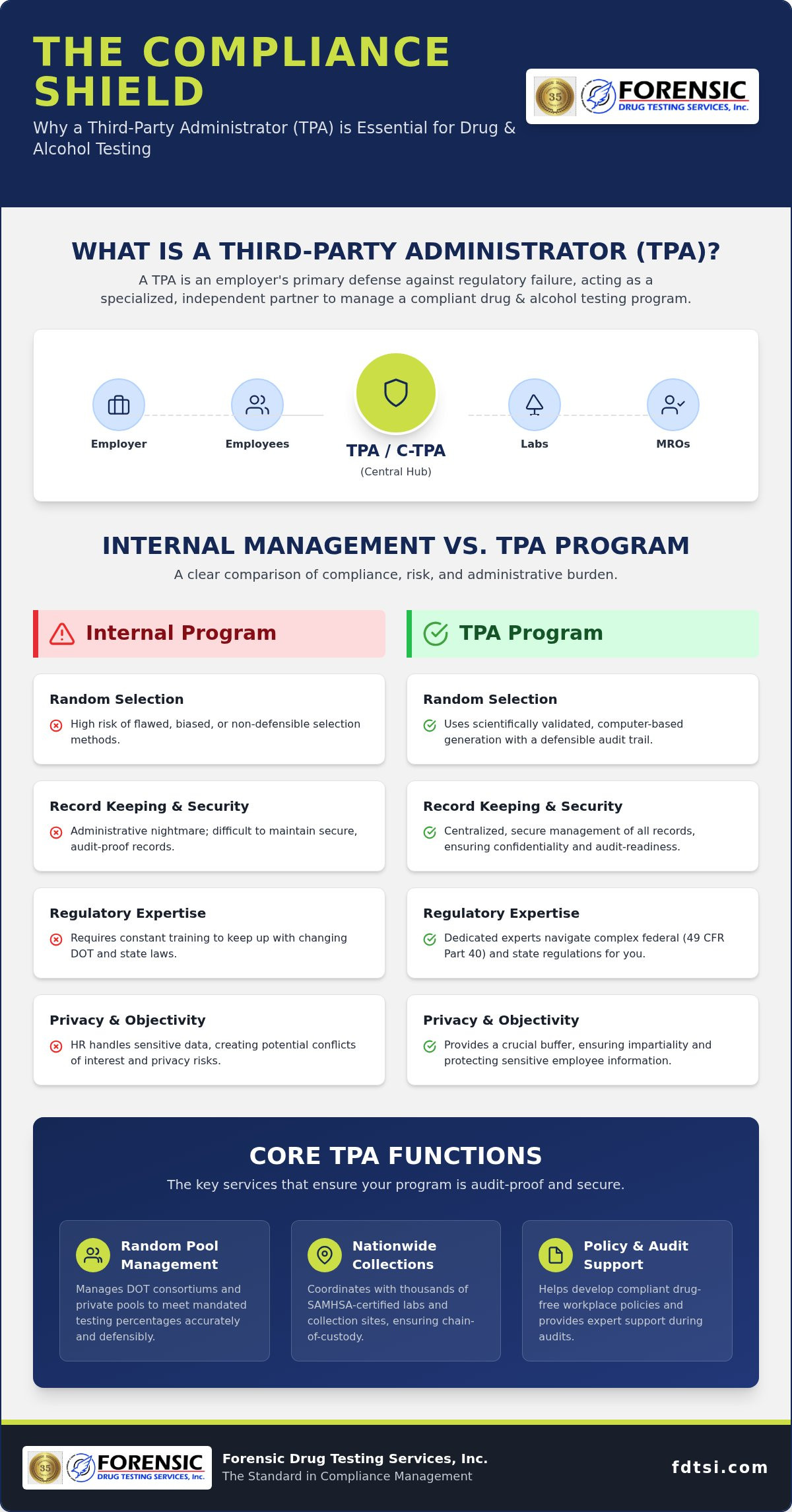
A Third Party Administrator (TPA) is a professional organization that manages all or part of an employer's drug and alcohol testing program. For companies regulated by the Department of Transportation (DOT), this entity is referred to as a Consortium/Third-Party Administrator (C/TPA). The C/TPA acts as an intermediary, coordinating the complex interactions between the employer, the employee, collection sites, laboratories, and Medical Review Officers (MROs).
The core purpose of a TPA is to provide specialized, independent oversight. This separation ensures that every step of the testing process—from random employee selection to final result reporting—is handled with impartiality and strict adherence to regulatory protocols. At its foundation, a TPA like Forensic Drug Testing Services (Forensic DTS) provides a layer of forensic accuracy and legal defensibility that is nearly impossible to replicate with an internal program.
- Formal Definition: A TPA is an agent for the employer, tasked with implementing and managing a compliant drug and alcohol screening program.
- The Core Relationship: The TPA centralizes communication and data flow, ensuring laboratories are SAMHSA-certified, MROs are properly credentialed, and collection sites follow strict chain-of-custody procedures.
- Administrative Duties: Key responsibilities include managing random testing pools, maintaining secure records, coordinating test collections, ensuring MRO review, and reporting results to the employer’s Designated Employer Representative (DER).
- Forensic Accuracy: The "Forensic" standard implies a process built to withstand legal and regulatory scrutiny. Every action is documented, defensible, and executed according to established rules, protecting the employer from liability.
The Role of the C/TPA in DOT Compliance
For businesses under the purview of DOT agencies like the Federal Motor Carrier Safety Administration (FMCSA), Federal Aviation Administration (FAA), or Federal Railroad Administration (FRA), using a C/TPA is a strategic necessity. These industries face stringent federal mandates outlined in 49 CFR Part 40, which details the procedures for every aspect of workplace drug and alcohol testing.
A C/TPA like Forensic DTS specializes in navigating these complex rules. A primary function is managing a "consortium," a random testing pool that combines employees from multiple small companies. This allows smaller fleets and owner-operators to meet the DOT’s statistical requirements for random testing in a cost-effective manner. The C/TPA ensures the consortium meets the mandated annual testing percentages and that every test, from pre-employment to post-accident, is executed flawlessly according to federal law.
TPA Services for Non-Regulated Employers
While the C/TPA role is critical for DOT compliance, a TPA also provides immense value to non-regulated private employers. Creating a fair, effective, and legally sound drug-free workplace program requires navigating a complex web of state-specific laws, especially concerning marijuana legalization and employee rights.
Forensic DTS extends its forensic-level precision to non-regulated employers by developing and managing customized programs. This includes crafting drug-free workplace policies that are tailored to the company's culture and specific state laws, implementing a mix of instant screening and laboratory-confirmed tests, and managing the entire process to reduce the employer's legal risk. A TPA provides the expert guidance needed to enforce a safety-conscious policy while respecting employee privacy and legal protections.
Internal Management vs. TPA: A Compliance Comparison
The decision to manage a drug testing program internally versus outsourcing to a TPA is a critical one. While internal management may seem like a way to save money, it often introduces hidden costs, significant administrative burdens, and substantial legal risks. The risk of "accidental non-compliance" is high, particularly in areas like random selection protocols, where a flawed process can invalidate an entire program during an audit.
A professional TPA provides a crucial buffer between HR personnel and sensitive employee medical information, protecting privacy and ensuring objectivity. For companies operating across multiple states, a TPA’s national network of collection sites provides scalability that is impossible to manage internally. The table below outlines the key differences.
| Feature | Internal Program Management | TPA Program Management (The Forensic DTS Model) |
|---|---|---|
| Random Selection | High risk of flawed, biased, or non-defensible selection methods. Requires validated software and rigorous documentation. | Utilizes scientifically validated, computer-based random generation. Provides a defensible audit trail for every selection. |
| Administrative Burden | Staff must manage multiple vendor relationships (labs, MROs, collection sites), track compliance percentages, and handle all paperwork. | A single point of contact. Forensic DTS manages all vendor logistics, paperwork, and compliance tracking, freeing up internal resources. |
| Regulatory Expertise | Requires continuous training to keep up with changing federal (DOT) and state-specific laws. High risk of missing critical updates. | Dedicated compliance experts whose sole job is to monitor regulatory changes. Forensic DTS proactively updates policies and procedures. |
| Audit Support | The employer bears the full burden of producing records and defending the program's integrity during an audit. | Acts as a specialized consultant during an audit. Forensic DTS provides a complete, organized, and defensible record of the entire program. |
| Cost Structure | Multiple invoices from labs, collectors, and MROs. Hidden costs in staff time, training, and potential non-compliance fines. | Consolidated, predictable billing. Eliminates hidden costs and reduces the risk of expensive fines, delivering a higher ROI. |
| Data Privacy | Risk of internal staff mishandling sensitive employee medical data, creating potential HR and legal conflicts. | Provides an impartial buffer, ensuring medical information is handled securely and only necessary results are reported to the employer. |
Administrative Burden and Cost Analysis
The true cost of an internal program extends far beyond test fees. It includes the hours your staff spends managing FMCSA Clearinghouse queries, scheduling collections, chasing down paperwork, and staying current on regulations. Each of these tasks represents a "time-cost" that detracts from core business operations. Furthermore, the Designated Employer Representative (DER) requires specialized training to perform their duties effectively, adding another layer of expense.
The consolidated billing model used by Forensic DTS simplifies this entire process. Instead of juggling dozens of invoices from collection sites across the country, you receive one clear, itemized statement. This streamlines accounting and provides a predictable, transparent cost structure for your entire drug testing program.
Legal Security and Audit Protection
During a DOT audit, investigators scrutinize every detail of your program. They will demand proof of truly random selections, complete chain-of-custody forms, MRO-verified results, and a perfect audit trail. Any gap or inconsistency can be flagged as a violation.
Hiring an expert TPA like Forensic DTS is akin to retaining a specialized consultant for audit defense. We maintain a defensible, moment-by-moment record of every action taken within your program. The TPA workflow inherently includes the critical step of MRO review, where a licensed physician verifies all laboratory results, investigates any legitimate medical explanations for findings, and ensures the final reported result is 100% accurate and legally sound. This process is your best protection against legal challenges and regulatory penalties.
Core Functions of a Professional TPA Program
A comprehensive TPA program is more than just a scheduling service. It is a fully integrated compliance system designed to manage every facet of your drug and alcohol testing requirements. A top-tier TPA provides a suite of services that work in concert to deliver seamless, error-free administration.
- Random Testing Pool Management: Ensuring true statistical randomness to meet DOT and company policy standards.
- Medical Review Officer (MRO) Services: Providing the final, expert medical review of test results to ensure accuracy and fairness.
- FMCSA Clearinghouse Management: Handling all mandatory queries, violation reporting, and return-to-duty process tracking.
- Collection Site Network Management: Maintaining a vast, vetted network of collection sites to ensure nationwide accessibility for your employees.
Random Testing Pool Administration
Proper random testing pool management is a science. Professional TPAs use validated software to generate truly random selections, removing any possibility of human bias. This is a cornerstone of a defensible DOT program. Forensic DTS manages this process with meticulous care, ensuring that selection cycles (whether quarterly or monthly) are executed on time and that the annual testing percentage rates mandated by the DOT are met. We also manage the difficult logistics of "missed" tests, documenting every attempt to notify an employee and ensuring the integrity of the random pool is never compromised.
FMCSA Clearinghouse Services
The FMCSA Clearinghouse is a mandatory federal database that tracks drug and alcohol violations for CDL drivers. Employers are required to conduct specific queries before hiring a driver and at least annually for all current drivers. They must also report any violations in a timely manner. This creates a significant and ongoing administrative task.
Forensic DTS's Clearinghouse management services remove this entire burden from your team. We conduct all required pre-employment and annual queries on your behalf, report violations accurately and on time, and assist drivers and employers in navigating the complex return-to-duty (RTD) process following a violation. This expert oversight ensures you remain in full compliance with all Clearinghouse mandates without dedicating internal staff to the task.
Specialized Regulatory Landscapes: California and Beyond
While federal DOT regulations provide a baseline, many industries and states have their own specific layers of compliance. A generic, one-size-fits-all TPA cannot effectively manage these nuances. This is particularly true in California, where state-level agencies impose additional, stringent requirements on employers.
A TPA with localized expertise is essential for multi-state operators and California-based businesses. This includes navigating:
- California Public Utilities Commission (PUC) rules for passenger carriers.
- California Highway Patrol (CHP) requirements for the Basic Inspection of Terminals (BIT) program.
- Contractor Safety Programs (CSPs) like VeriForce, which have their own testing standards for utility and energy contractors.
- State-specific marijuana laws that impact non-regulated workplace policies.
California-Specific Compliance Requirements
With deep roots and specialized expertise in California, Forensic DTS offers unparalleled guidance on the state's unique regulatory environment. The CHP's BIT program requires commercial vehicle operators to maintain a compliant drug and alcohol testing program as a condition of passing their terminal inspection. Failure to produce the correct records can result in a terminal being shut down.
Similarly, PUC-regulated passenger carriers have specific random testing requirements and mandatory policy language that must be included in their drug-free workplace programs. Forensic DTS ensures these state-level mandates are perfectly integrated with federal DOT rules, creating a single, cohesive compliance strategy that satisfies all governing bodies.
Contractor Safety Programs (CSP)
Many large industrial, energy, and utility companies require their contractors to subscribe to a Contractor Safety Program (CSP) like VeriForce, ISNetworld, or Avetta. These programs mandate strict drug and alcohol testing protocols as a condition of working on-site. The reporting and compliance requirements are often complex and time-sensitive.
Forensic DTS is experienced in managing these CSP requirements. We help clients streamline their testing and reporting to ensure their employees maintain the necessary qualifications, preventing delays and ensuring continuous access to critical jobsites.
Selecting the Right TPA: Why Forensic DTS is the Standard
Choosing a TPA is a decision that directly impacts your company's financial health and legal standing. You need a partner with a proven track record, deep regulatory knowledge, and an unwavering commitment to accuracy. Forensic Drug Testing Services, Inc. was established in 1991 to provide precisely this level of forensic-level reliability.
- Decades of Experience: With over 30 years in the industry, Forensic DTS has the seasoned expertise to handle any compliance scenario.
- Nationwide Reach, Localized Knowledge: We offer a nationwide network of collection sites while providing specialized, expert guidance on complex local regulations, particularly in California.
- Comprehensive Services: We are a full-service administrator, managing everything from DOT consortiums and FMCSA Clearinghouse queries to non-regulated policy production and even specialized DNA paternity testing.
- Authoritative Guidance: Our mission is to be more than a service provider; we are your compliance partner, offering authoritative guidance on policy and implementation.
The Forensic DTS Approach to Policy Production
A generic, off-the-shelf drug-free workplace policy is a significant liability. These templates often fail to address state-specific laws, industry nuances, or new challenges like the prevalence of CBD products. In a legal challenge or during an audit, a flawed policy can be worse than no policy at all.
The Forensic DTS approach is to produce customized policies built for your specific corporate culture and regulatory environment. We work with you to understand your operational needs and legal obligations, crafting a policy that is both effective and defensible. Our team stays ahead of legislative changes, ensuring your policies are updated to reflect future standards and evolving legal interpretations.
Getting Started with a TPA
Transitioning from internal management or another TPA to Forensic DTS is a seamless and structured process. Our onboarding team works directly with you to transfer driver rosters, review existing policies, and integrate your company into our system with minimal disruption. For new businesses or owner-operators, we provide a clear, step-by-step path to full compliance, starting with enrollment in our DOT consortium.
Stop gambling with compliance. Eliminate the administrative burden and secure your company's future with a partner built on a foundation of forensic accuracy and unwavering expertise.
Secure your compliance with Forensic DTS today.
Frequently Asked Questions (FAQ)
**What is the difference between a TPA and a C/TPA?
** A TPA (Third Party Administrator) manages drug testing programs, typically for non-regulated employers. A C/TPA (Consortium/Third-Party Administrator) is a TPA that specializes in managing programs for DOT-regulated employers, including the operation of a consortium (a random testing pool for multiple employers).
**Does a TPA provide the actual drug testing collection sites?
** A TPA does not typically own the collection sites. Instead, a professional TPA like Forensic DTS manages a vast, nationwide network of qualified collection sites, laboratories, and MROs. We handle the scheduling, logistics, and quality control to ensure every test is performed correctly, no matter where your employees are located.
**Is an employer still responsible for compliance if they hire a TPA?
** Yes, according to the DOT, the employer is ultimately responsible for their own compliance. However, hiring a reputable TPA is considered a best practice for meeting that responsibility. The TPA acts as your agent, and their expertise and documentation are your primary means of demonstrating good-faith compliance during an audit.
**How much does a drug testing consortium membership typically cost?
** Consortium membership costs vary but generally involve an annual fee per driver. This fee covers the administrative costs of random pool management, record-keeping, and compliance oversight. Individual test fees (e.g., for pre-employment or post-accident tests) are typically billed separately. Contact Forensic DTS for a detailed quote based on your specific needs.
**Can a TPA manage both DOT and non-DOT drug testing programs?
** Yes, a full-service TPA like Forensic DTS is equipped to manage both programs simultaneously. We can run a compliant DOT program for your regulated employees while administering a separate, customized program for your non-regulated staff, ensuring the distinct rules for each are followed perfectly.
**What is the role of an MRO in a TPA-managed program?
** The Medical Review Officer (MRO) is a licensed physician who acts as an independent and impartial "gatekeeper" of test results. The MRO receives results from the laboratory, reviews them for accuracy, and contacts the employee to determine if there is a legitimate medical explanation for a non-negative result before reporting the final, verified result to the employer. This is a critical step for ensuring legal and scientific accuracy.
**How often does a TPA perform random selections for a consortium?
** Selection frequency can vary. While some TPAs may select quarterly, Forensic DTS often recommends monthly selections for safety-sensitive roles. More frequent selections help ensure the testing rates are met consistently throughout the year and maintain a strong deterrent effect.
**Does Forensic DTS provide nationwide drug testing services?
** Yes. Forensic DTS provides comprehensive, nationwide services. Through our extensive network of collection sites and laboratories across the United States, we can manage the drug and alcohol testing needs for companies of all sizes, from single owner-operators to large, multi-state fleets.

