

Managing a random drug testing pool can feel like navigating a minefield of federal regulations and administrative headaches. For HR managers and fleet owners, the fear is real: one misstep, one poorly documented selection, or one out-of-date employee list could trigger a failed DOT audit, leading to steep fines and even a loss of operating authority. You’re not just trying to check a box; you’re trying to protect your business from significant legal and safety risks. But the jargon is dense, the rules are complex, and the stakes are incredibly high.
Many believe they can manage this process with a simple spreadsheet, but that common misconception is a direct path to non-compliance. True random drug testing pool management is not about haphazardly picking names. It is a rigorous, legally defensible system designed to ensure fairness, unpredictability, and unwavering adherence to government standards. This guide will demystify the process, explain your options, and show you how professional oversight is the most effective shield for your company.
What is Random Drug Testing Pool Management?
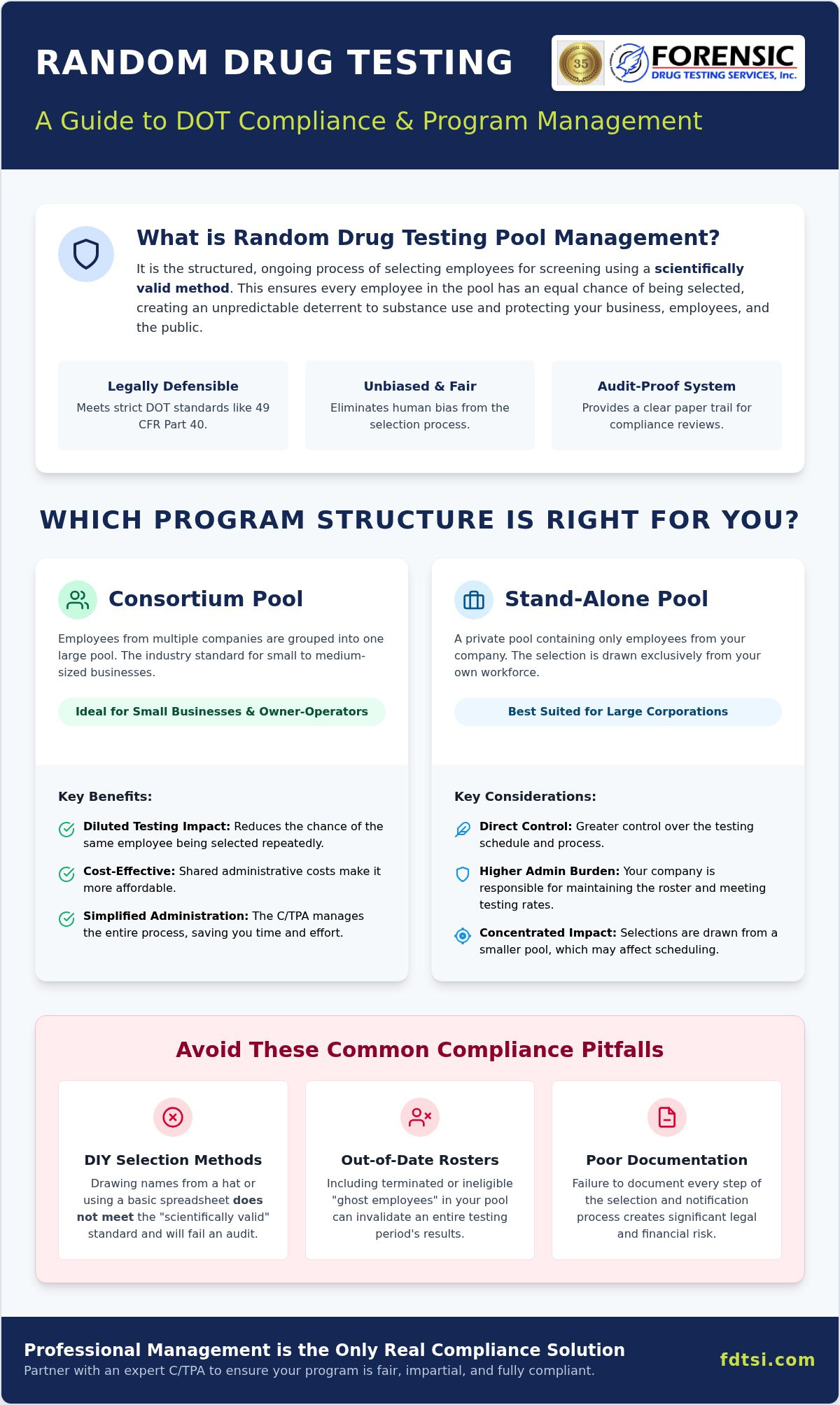
At its core, random drug testing pool management is the structured, ongoing process of selecting employees for drug and alcohol screening using a scientifically valid method. This ensures that every employee in the pool has an equal chance of being selected during any given testing period. The goal is to create an unpredictable deterrent to substance use in safety-sensitive positions, thereby protecting your employees, your assets, and the public.
This process is overseen by the employer, or more commonly, a designated Consortium/Third-Party Administrator (C/TPA). A C/TPA like Forensic Drug Testing Services, Inc. acts as an impartial agent, managing the entire lifecycle of the random testing program—from maintaining the employee roster to ensuring the selection process is scientifically sound and legally defensible.
- The System: It's far more than just a list of names. It’s a complete system that includes maintaining an accurate employee roster, using validated selection software, documenting every step, and ensuring compliance with specific regulatory testing rates.
- The Role of a C/TPA: A C/TPA brings expertise and impartiality. They manage the complexities of compliance, freeing you to focus on your core business operations. Forensic Drug Testing Services, Inc. specializes in this oversight, ensuring your program is audit-proof.
- Why DIY Fails: Simple methods like pulling names from a hat or using a basic spreadsheet function do not meet the DOT's strict definition of a "scientifically valid" method. These approaches can introduce bias, are difficult to document properly, and will not stand up to scrutiny during an audit.
- The 'Clean' List: A critical component is maintaining an active and updated participant list. The pool must only contain current, eligible employees. Including terminated or ineligible employees (often called 'ghost employees') can invalidate your entire testing process for a given period.
The Legal Necessity of Scientifically Valid Selection
The phrase "scientifically valid method" is not just regulatory jargon; it is a legal standard with specific requirements under federal law, particularly 49 CFR Part 40. This mandate is the bedrock of any compliant random testing program. It exists to eliminate human bias, whether intentional or unintentional, from the selection process.
This means that on any given selection day, every single employee in the pool must have the exact same mathematical probability of being chosen. Methods that could favor or overlook certain individuals—such as picking from a list alphabetically or choosing employees who happen to be in the office that day—are strictly prohibited. At Forensic Drug Testing Services, Inc., we utilize sophisticated, computer-based algorithms designed specifically to meet this federal standard. These programs generate a truly random selection and create an unassailable digital paper trail, proving to auditors that your process is fair, impartial, and fully compliant.
Regulated vs. Non-Regulated Pools
While often associated with the Department of Transportation (DOT), random testing pools are used by a wide range of organizations. Understanding the distinction between regulated and non-regulated pools is crucial for proper management.
- DOT-Regulated Pools: These are mandated by federal law for safety-sensitive employees under agencies like the Federal Motor Carrier Safety Administration (FMCSA), Federal Aviation Administration (FAA), and others. The rules are rigid and non-negotiable, covering everything from testing rates and methodologies to reporting requirements through systems like the FMCSA Clearinghouse.
- Non-Regulated Pools: Many private companies choose to implement random testing as part of a comprehensive drug-free workplace program. This provides a powerful deterrent to substance abuse, reducing accidents and improving productivity. While not bound by DOT rules, these programs must still be managed carefully and based on a clear, written company policy to avoid legal challenges. Forensic Drug Testing Services, Inc. helps private employers design and manage custom pools that meet their specific safety goals while respecting state laws and employee rights.
Consortium vs. Stand-Alone Pools: Which Structure Fits Your Business?
When setting up a random testing program, especially for DOT-regulated businesses, you have two primary structural options: joining a consortium or managing a stand-alone pool. The right choice depends almost entirely on the size of your workforce and your administrative capacity.
For many small business owners and independent owner-operators, the decision is simple. Joining a consortium pool managed by a C/TPA like Forensic Drug Testing Services, Inc. is the most efficient, cost-effective, and secure path to compliance. For large corporations, the control offered by a stand-alone pool may be more appealing.
Benefits of the Consortium Model
A consortium is a large pool of employees from multiple, independent companies. This model is the industry standard for small businesses and owner-operators for several key reasons:
- Diluted Testing Impact: The DOT mandates specific annual testing percentages (e.g., 50% for drugs, 10% for alcohol for the FMCSA). In a small company with only two drivers, this would mean one driver is tested for drugs and one quarter of a driver is tested for alcohol each year, which is statistically impossible. A consortium solves this by grouping hundreds or thousands of employees together. Your two drivers join a much larger pool, ensuring the overall testing rates are met without over-testing your small staff.
- Reduced Administrative Burden: As a member of a consortium managed by Forensic Drug Testing Services, Inc., you offload the complex administrative tasks. We handle the scientifically valid selections, the record-keeping, the notifications, and the annual reporting. This frees you from the constant worry of compliance details.
- Guaranteed Compliance: A professionally managed consortium automatically ensures that the required annual testing percentages are met across the entire pool. This provides peace of mind that you are fulfilling your regulatory obligations correctly.
When to Choose a Stand-Alone Pool
A stand-alone pool consists exclusively of employees from a single company. This model is typically reserved for larger businesses with a significant number of safety-sensitive employees, usually 50 or more.
- Total Control: With a stand-alone pool, a company maintains complete control over its employee list, testing schedules (within the bounds of randomness), and data. This can be advantageous for organizations with complex internal structures or specific operational needs.
- Customization: Large workforces may have various safety-sensitive roles with different requirements. A stand-alone pool allows for greater customization in how these groups are managed and tested.
- Direct Integration: Companies with sophisticated in-house HR and safety software may prefer a stand-alone model to integrate testing data directly with their existing systems. Even in this scenario, many large companies still hire a C/TPA like Forensic Drug Testing Services, Inc. to manage the pool to ensure impartiality and leverage specialized compliance expertise.
The Lifecycle of an Effective Random Testing Program
Effective random drug testing pool management is a continuous cycle, not a one-time event. Each step in the process is critical for maintaining a defensible and compliant program. Missing or mishandling any one of these stages can jeopardize the entire system. At Forensic Drug Testing Services, Inc., we manage this lifecycle with procedural precision, ensuring nothing falls through the cracks.
- Step 1: Updating the 'Eligibility List': The process begins with a clean, accurate, and up-to-date list of every employee subject to random testing. This roster is the foundation of the entire program. It must be regularly purged of terminated employees and updated with new hires.
- Step 2: The Selection Event: Using a validated software program, a random selection of names is generated from the eligibility list. This is done at a predetermined frequency (e.g., monthly or quarterly) to ensure the annual testing rates are met. The selection itself must be unpredictable.
- Step 3: Notification and Testing: Once selected, employees must be notified and instructed to proceed to a collection site for testing immediately. This immediacy is a crucial element designed to prevent any attempts to adulterate or substitute a specimen.
- Step 4: Result Reporting and Record-Keeping: Test results are securely reported back from the laboratory to the C/TPA or employer. For DOT-regulated programs, this includes meticulous record-keeping and, in the case of the FMCSA, reporting relevant results to the FMCSA Clearinghouse.
Updating the Eligibility List
The danger of an outdated employee roster cannot be overstated. If your pool contains "ghost employees"—individuals who have left the company but were never removed from the list—it can artificially dilute the pool. If a ghost employee is selected, it creates a documentation nightmare and can cause you to fall short of your required testing numbers for the year. This is a common and easily avoidable audit failure. At Forensic Drug Testing Services, Inc., we work proactively with our clients, sending regular reminders and providing simple tools to streamline list maintenance, ensuring your pool is always a precise reflection of your current workforce.
Notification Protocols and Testing Windows
The DOT requires that a random test be unannounced and that the employee proceeds to the testing site "immediately" after notification. This isn't a suggestion; it's a core principle of the program. The element of surprise is what makes random testing an effective deterrent. Any delay between notification and collection provides an opportunity for an individual to attempt to subvert the test.
Of course, real-world situations arise. What if an employee is on a scheduled vacation or out on sick leave when their name is selected? A compliant program, supported by a clear company policy, has protocols for this. The selection is documented, the reason for the employee's unavailability is recorded, and that employee returns to the pool with an equal chance of being selected in the next cycle. You do not "reschedule" the test for their return, as that would eliminate the element of randomness. Handling these exceptions correctly requires expertise, and it's a key area where a C/TPA provides immense value.
Avoiding Common Pitfalls in Random Pool Administration
Even with the best intentions, it's easy for companies managing their own random testing pools to fall into common traps that lead to non-compliance. These pitfalls are often the first things an auditor looks for, and they can turn a routine inspection into a costly ordeal. With over three decades of experience, the team at Forensic Drug Testing Services, Inc. has seen every potential mistake and has built systems to prevent them.
- Failing to Meet Annual Percentages: This is the most frequent violation. Whether due to poor tracking, outdated employee lists, or missed tests, failing to meet the minimum required testing rates (e.g., 50% for drugs under FMCSA) is a guaranteed audit failure.
- Predictable Testing Patterns: A program that only pulls names on the last Friday of every quarter is not truly random; it’s predictable. An effective program spreads selections unpredictably throughout the year, across different days of the week and different shifts, to maintain a constant deterrent.
- Lacking a Written Policy: Your random testing program is legally vulnerable without a comprehensive, written drug-free workplace policy. This document is the foundation that gives you the authority to test and outlines the procedures and consequences for your employees.
- Incomplete Record-Keeping: If it isn’t documented, it didn’t happen. Auditors will demand to see records of every selection event, every test result, and every instance of an employee being unable to test. This includes the annual DOT MIS (Management Information System) reports, which require meticulous data compilation.
The Trap of Predictable Testing
It’s human nature to seek patterns and create routines. An HR manager juggling multiple responsibilities might fall into the habit of running the random selection on the same day each month. Employees quickly pick up on these patterns, which completely undermines the deterrent effect of the program. The goal is for every employee to know that they could be selected on any given day they are at work. Professional managers at Forensic Drug Testing Services, Inc. are trained to ensure true unpredictability. We vary the timing and frequency of selections to ensure the program remains a powerful safety tool, not just a predictable administrative task.
Policy Production: The Foundation of Your Pool
A random testing pool without a supporting policy is like a house with no foundation. The policy is the legal document that establishes your company's drug and alcohol testing program. It informs employees of their responsibilities and outlines the consequences of a violation. Without it, any disciplinary action you take based on a test result could be subject to a legal challenge.
Furthermore, policy requirements can vary. A company operating in California, for example, must navigate specific state laws in addition to federal DOT mandates. Creating a policy that is both compliant and legally sound is a complex task. Forensic Drug Testing Services, Inc. offers expert policy development, crafting documents that are tailored to your business, compliant with all applicable federal and state laws, and provide the legal authority you need to enforce your drug-free workplace standards.
Why Professional Management is the Only Real Compliance Solution
When you weigh the modest annual fee for professional C/TPA services against the cost of a single failed DOT audit—which can include thousands of dollars in fines, legal fees, and the potential suspension of your operations—the return on investment becomes clear. Outsourcing your random drug testing pool management is not an unnecessary expense; it is a strategic investment in risk mitigation and operational continuity.
Since 1991, Forensic Drug Testing Services, Inc. has been dedicated to providing this procedural mastery. We act as your compliance partner, a specialized consultant that brings order to the chaos of regulation. We manage the details so you can focus on running your business, confident that your program is always audit-ready.
Our services go beyond simple random selections. We provide fully integrated management that includes FMCSA Clearinghouse queries, reporting, and record-keeping, ensuring every piece of your compliance puzzle fits together perfectly. This holistic approach provides the ultimate peace of mind for your safety program.
Audit-Ready Record Keeping
DOT regulations require that you maintain detailed records of your drug and alcohol testing program for up to five years. During an audit by the DOT, CHP, or PUC, you will be asked to produce these records on demand. Scrambling to find years-old paperwork is a stressful and error-prone process. As a client of Forensic Drug Testing Services, Inc., you have instant, organized access to all your compliance documentation. Our system is designed to make audits a smooth, stress-free event, allowing you to produce the necessary records with confidence and ease.
Nationwide Coverage, Local Expertise
For companies with a mobile or distributed workforce, managing testing logistics can be a significant challenge. Forensic Drug Testing Services, Inc. operates a vast, nationwide network of collection sites, ensuring your employees can get tested quickly and conveniently, no matter where their work takes them. This national reach is paired with deep local expertise. We have specialized knowledge of complex regulatory environments like California, ensuring your program is compliant not just with federal mandates, but with state-specific requirements as well.
Don't leave your company's future to chance. Protect your authority with professional pool management at Forensic DTS.
Frequently Asked Questions (FAQs)
**What is a DOT drug testing consortium?
** A DOT drug testing consortium is a group of independent companies that join a single, larger random testing pool managed by a C/TPA. This allows smaller companies to meet the DOT's annual percentage testing requirements in a statistically valid and cost-effective manner.
**How many employees are required for a stand-alone random pool?
** There is no strict legal minimum, but stand-alone pools are generally recommended for companies with 50 or more safety-sensitive employees. With fewer employees, it becomes statistically difficult to meet the annual testing rates without over-testing your staff, making a consortium a more practical choice.
**What happens if an employee is selected for a random test while on vacation?
** If an employee is on a documented, pre-approved absence like vacation or sick leave, the test cannot be conducted. The proper procedure is to document the selection and the reason for the employee's unavailability. The employee then returns to the pool and has the same equal chance as everyone else of being selected in the next cycle. The test is not "rescheduled" for their return.
**Are owner-operators required to be in a random testing pool?
** Yes. An owner-operator who holds a CDL and operates a commercial motor vehicle is considered an employee of their own business and must be enrolled in a DOT-compliant random testing consortium. They cannot manage their own random testing.
**How often should I update my random testing eligibility list?
** Your list should be updated as soon as an employee's status changes. Best practice is to review and formally update the list with your C/TPA at least quarterly, but ideally monthly, to ensure all new hires are included and all terminated employees are removed promptly.
**Can I manage my own random drug testing pool using a spreadsheet?
** No. The DOT requires a "scientifically valid method" for random selection, which a standard spreadsheet program cannot provide or properly document. Using a spreadsheet lacks the necessary safeguards against bias and fails to create the auditable proof of randomness that regulators require.
**What are the 2026 FMCSA random drug testing rates?
** The annual random testing rates are determined by the FMCSA Administrator based on industry-wide violation data from the previous year. These rates are typically announced at the end of the calendar year for the following year. For 2026, you should consult the official FMCSA website or your C/TPA, like Forensic Drug Testing Services, Inc., for the confirmed rates once they are released.
**How does the FMCSA Clearinghouse affect random pool management?
** The FMCSA Clearinghouse is deeply integrated with random testing. Employers are required to run pre-employment queries and annual queries on all drivers. Furthermore, any drug or alcohol violations discovered through the random testing program must be reported to the Clearinghouse. A C/TPA like Forensic Drug Testing Services, Inc. typically manages these Clearinghouse duties as part of a comprehensive compliance service.

