

Regulatory compliance is not a matter of chance; it is the result of disciplined procedural mastery. For motor carriers and owner-operators, the risk of a DOT audit is a constant reality that demands more than just basic participation in a testing pool. Joining a specialized DOT drug testing consortium is the only way to transform regulatory chaos into a structured legal shield. You already know that the administrative burden of random selections and FMCSA Clearinghouse requirements can easily interfere with your daily operations. The fear of massive fines for a simple oversight is valid, especially as federal oversight becomes increasingly rigorous.
This 2026 guide ensures you remain in total control of your compliance standing. We provide the technical clarity you need to secure your DOT authority and maintain records that are perpetually audit-ready. You'll learn about the current 50% random drug testing rate for FMCSA, the latest updates on oral fluid testing implementation, and the specific steps required to eliminate administrative interference. This overview serves as a professional roadmap to achieving total regulatory certainty and protecting your business from the consequences of non-compliance.
Key Takeaways
- Understand the legal requirements of the C/TPA model and why participation in a mandatory random testing pool is essential for maintaining federal compliance.
- Identify critical selection criteria for a DOT drug testing consortium, including nationwide collection site accessibility and specialized expertise in agency-specific mandates.
- Learn how professional pool management serves as a protective shield during DOT audits, preventing costly fines and out-of-service orders.
- Master the step-by-step process for driver enrollment and the seamless integration of FMCSA Clearinghouse management into your administrative workflow.
- Leverage the expertise of a seasoned veteran to ensure your policy production and testing protocols meet the rigorous standards of 2026 federal regulations.
Understanding the DOT Drug Testing Consortium (C/TPA) Model
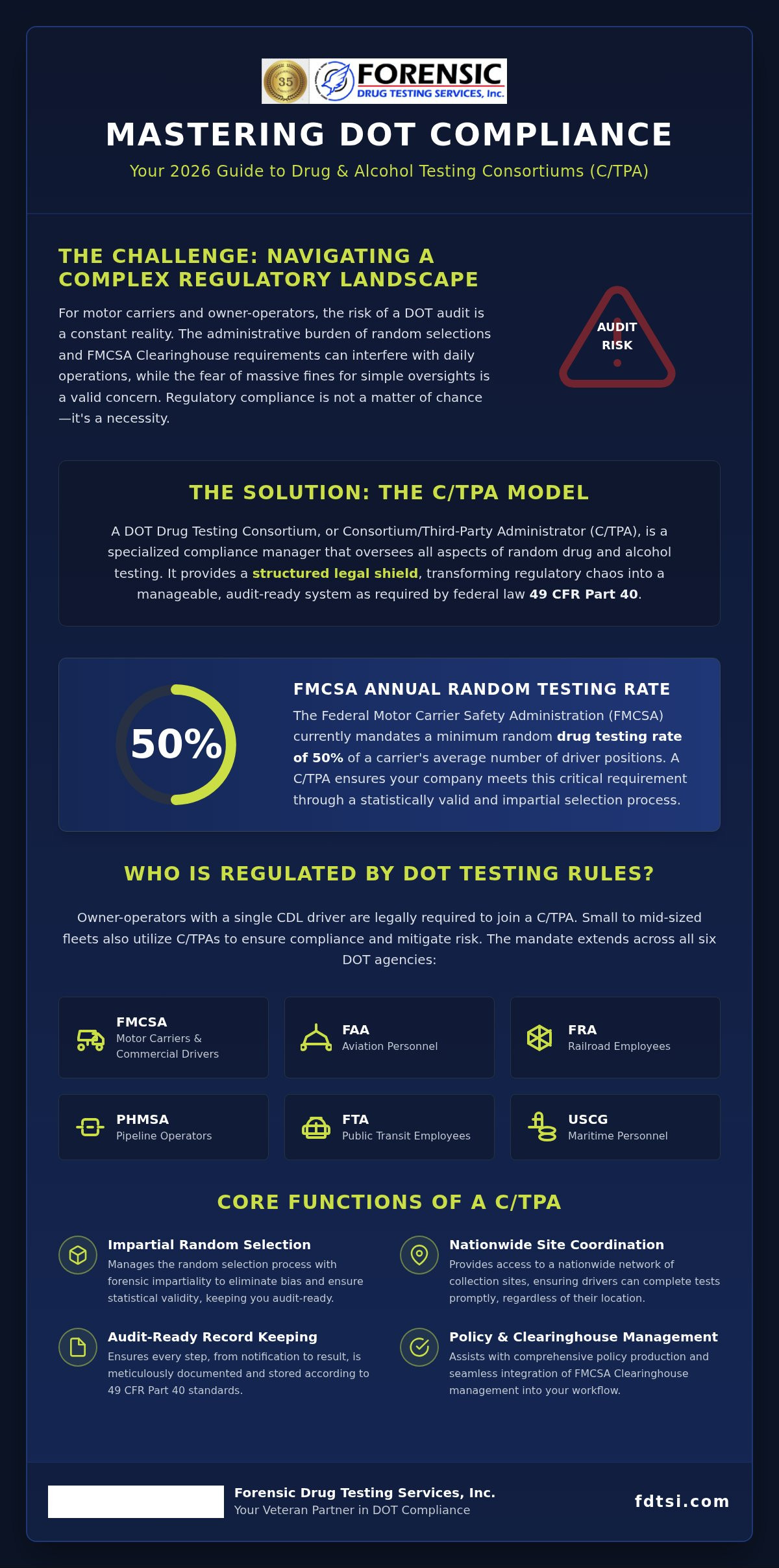
A DOT drug testing consortium acts as a specialized compliance manager that oversees all aspects of random drug and alcohol testing for regulated employers. Under federal law, specifically 49 CFR Part 40, these entities are officially designated as Consortium/Third-Party Administrators (C/TPAs). They provide a structured framework for employers who must adhere to Department of Transportation (DOT) mandates but lack the internal infrastructure to manage complex testing pools. The regulatory mandate for random testing isn't a suggestion; it's a rigorous requirement designed to ensure safety-sensitive employees are fit for duty. By utilizing a DOT drug testing consortium, small fleets and individual operators aggregate into a single, statistically valid pool. This collective approach ensures that random selection percentages meet federal requirements while distributing the administrative burden across a professionally managed system.
Who is Required to Join a Consortium?
Federal regulations distinguish between large employers with internal programs and smaller entities that require external oversight. Owner-operators with a single CDL driver are legally required to join a C/TPA to ensure the integrity of the random selection process. Small to mid-sized fleets often choose this model to mitigate the risk of administrative errors that lead to significant fines. While the FMCSA is the most common agency associated with these requirements, the mandate extends to all DOT-regulated sectors. This includes the following agencies:
- FMCSA: Motor carriers and commercial drivers.
- FAA: Aviation personnel in safety-sensitive roles.
- FRA: Railroad employees and maintenance-of-way staff.
- PHMSA: Pipeline operators and contractors.
- FTA: Public transit employees.
- USCG: Maritime personnel and commercial vessel crews.
Each agency has specific random testing rates that must be strictly maintained to keep your operating authority secure and your records audit-ready.
The Role of the C/TPA in Your Compliance Strategy
The C/TPA functions as a protective shield between your business and federal auditors. A primary responsibility involves managing the random selection process with forensic impartiality to eliminate any perception of bias. This management includes coordinating with Medical Review Officers (MROs) and a nationwide network of collection sites to facilitate a standard drug test when a selection occurs. It's not just about the test itself; it's about the procedural adherence to 49 CFR Part 40 standards. Every step of the process must be documented and stored for audit purposes. Your consortium ensures that all testing protocols, from the initial notification to the final result verification, are handled with the precision required by federal law. This level of oversight provides the stability and certainty needed to navigate a complex regulatory environment without compromising your daily operations.
Evaluating DOT Consortium Membership: Critical Selection Criteria
Selecting a DOT drug testing consortium is a decision of legal consequence. It's not merely about finding a service provider. It's about securing a partner that understands the technicalities of 49 CFR Part 40. A provider's reach is the first metric for evaluation. For interstate fleets, nationwide collection site accessibility is non-negotiable. If a driver is selected for a random test while on a cross-country route, the consortium must have a pre-established network to facilitate immediate collection. A failure here is a failure in compliance.
Record keeping requires a manual-like, structured approach. Every document must be precise. Every date must be accurate. A seasoned veteran in this field doesn't just manage a pool; they provide comprehensive policy production. This ensures that your company's internal rules align perfectly with federal mandates. If your current program lacks this level of technical rigor, it's time to evaluate a more disciplined compliance strategy that protects your operating authority.
Agency-Specific Compliance Expertise
Does the consortium understand the nuances of FMCSA vs. FAA regulations? The requirements are not identical. For 2026, the FMCSA random drug testing rate is 50%, while the FAA rate is 25%. A high-level C/TPA must manage these diverse mandates with absolute accuracy. State-specific requirements add another layer of complexity. In California, motor carriers must navigate the California Highway Patrol (CHP) BIT program and Public Utilities Commission (PUC) mandates. According to the FMCSA, Consortium/Third-Party Administrators (C/TPAs) must provide the administrative oversight necessary to bridge these gaps. Expert policy development is required to align federal and state mandates into a single, cohesive compliance plan.
Forensic Accuracy and MRO Oversight
Forensic integrity depends on the Medical Review Officer (MRO). The MRO acts as an independent gatekeeper. They review laboratory results for accuracy and legitimate medical explanations. Every transaction must involve a qualified MRO to withstand legal scrutiny. Using DHHS-certified laboratories is a baseline requirement, but the management of the results is where the real work happens. Professional pool management involves handling complex testing scenarios. This includes managing "Negative Dilute" results, shy bladder issues, and refusals to test. These situations require immediate, procedurally correct action to prevent out-of-service orders. A disciplined consortium ensures that every step follows a strict, defensible protocol.
The ROI of Compliance: Protecting Your DOT Authority
Regulatory compliance is a financial safeguard. It protects the core of your operation: your DOT authority. Non-compliance results in more than just administrative friction. It leads to heavy civil penalties and immediate out-of-service orders. A professional DOT drug testing consortium functions as a specialized legal shield during these high-stakes moments. While some industry groups focus on the educational benefits of membership, the true value lies in audit defense. According to the FMCSA Definition of Consortium/Third-Party Administrators, these entities are tasked with ensuring the forensic integrity of the employer's program. A consortium membership is a fixed-cost insurance policy against unpredictable regulatory fines.
Managing compliance internally requires significant resources. Small fleets don't have the bandwidth for the meticulous record-keeping demanded by federal inspectors. Outsourcing to a C/TPA transfers this administrative burden to seasoned experts. This ensures that every selection is statistically valid and every record is defensible. It's a matter of operational efficiency. You focus on logistics; the consortium focuses on the law. This division of labor prevents the "paperwork errors" that often trigger deeper investigations into a carrier's safety profile.
Audit Support and Record-Keeping
Inspectors look for specific gaps during an audit. They prioritize the random selection history and proof of driver enrollment. An "audit-ready" file contains every notification, result, and chain of custody form. Your consortium prepares the annual Management Information System (MIS) reports required by federal agencies. If an investigator arrives, you need immediate access to historical testing data. A disciplined C/TPA provides this retrieval speed, ensuring you never appear disorganized or non-compliant under scrutiny.
Mitigating Liability and Operational Risk
Operational risk extends beyond government fines. It involves employee relations and accident protocols. "Wrongful selection" claims can disrupt a workplace and lead to litigation. A third-party administrator eliminates this risk by using a forensic, computer-generated selection process that is entirely impartial. Post-accident testing is another critical area where mistakes are costly. Federal timelines are strict. Alcohol tests must ideally occur within two hours; drug tests within 32 hours. Failure to meet these windows requires documented justification. A DOT drug testing consortium manages these timelines and the necessary "Reasonable Suspicion" documentation. This meticulous approach reduces your liability in the event of a legal challenge or a civil lawsuit.
Implementation Roadmap: Enrollment and Clearinghouse Integration
Implementation requires a systematic approach to driver management. The first step is the pre-employment screening. Every new hire must undergo a DOT drug test and a Clearinghouse query before performing safety-sensitive duties. This ensures immediate compliance and prevents high-risk individuals from entering your fleet. Once hired, drivers are enrolled into the random pool. A DOT drug testing consortium manages this enrollment to ensure the pool remains statistically valid throughout the year. For 2026, the FMCSA requires a 50% drug testing rate and a 10% alcohol testing rate. Maintaining these numbers is a matter of administrative precision. It's not just about testing; it's about the sequence of execution.
Mastering the FMCSA Clearinghouse
The FMCSA Clearinghouse is a central pillar of federal oversight. Employers must conduct pre-employment queries for all new CDL drivers. This is a full query that requires driver consent within the Clearinghouse portal. Annual queries are also mandatory for every driver currently on your roster. These limited queries check for new violations without requiring immediate portal consent unless a record is found. A C/TPA manages these tasks on behalf of the employer, ensuring that reporting drug and alcohol violations occurs within the required timelines. Failure to query or report is a direct violation that carries significant civil penalties. To streamline your administrative workflow, enroll in our FMCSA Clearinghouse management services today.
Maintaining the Driver Roster
Pool integrity depends on an accurate driver roster. You must have procedures for adding and removing drivers in real time. If a driver leaves the company, they must be removed from the consortium pool immediately to avoid phantom selections. Conversely, new hires must be added before the next quarterly selection occurs. Quarterly random selection notifications must be executed promptly. If a driver is unavailable during a selection window due to long-term medical leave or being off-duty, specific documentation is required to justify the delay or the selection of an alternate. This level of roster maintenance prevents gaps in your compliance history.
Federal law mandates supervisor training for all regulated employers. Any individual overseeing CDL drivers must complete at least 60 minutes of training on alcohol misuse and 60 minutes on controlled substance use. This training enables supervisors to make reasonable suspicion determinations. These determinations must be documented with forensic detail to survive an audit. Your consortium provides the resources to meet these mandatory training requirements, ensuring your leadership team can act decisively when safety is at risk. This training is a prerequisite for a defensible drug and alcohol program.
Forensic Drug Testing Services, Inc.: Your Veteran Partner in DOT Compliance
Forensic Drug Testing Services, Inc. has operated at the intersection of science and regulatory law since 1991. This longevity establishes the organization as the seasoned veteran in a field where procedural errors carry heavy consequences. Managing a DOT drug testing consortium requires more than a software platform; it demands a deep immersion in forensic standards and federal oversight. Our nationwide collection site network ensures that your fleet remains compliant regardless of where your drivers operate. We don't just provide a testing pool. We provide a disciplined, no-nonsense framework that protects your business from the volatility of the regulatory landscape.
Our comprehensive service suite is designed for total coverage. We manage DOT Regulated Consortium - C/TPA requirements and Non-Regulated Company Drug & Breath Alcohol Testing with the same level of professional rigor. Our expertise extends to Expert Policy Production, DNA Paternity Testing, and FMCSA Clearinghouse Management. We also facilitate ETG Urine Alcohol Testing, Instant Drug Screening, and VeriForce CSP Testing. Every service we offer follows a manual-like quality that prioritizes accuracy and procedural mastery above all else.
Why 30+ Years of Experience Matters
Regulatory shifts are constant. Since the inception of DOT testing mandates, Forensic Drug Testing Services, Inc. has navigated every change in 49 CFR Part 40. This experience translates to stability for our clients. We understand the technicalities of laboratory certification and MRO oversight because we've seen every scenario. Our reputation for accuracy isn't just about the results; it's about the defensibility of the process. During a DOT audit, you need a partner that acts as a shield. We provide the unwavering support and audit-ready records required to satisfy the most meticulous federal inspectors.
Getting Started with Forensic Drug Testing Services, Inc.
Securing your compliance standing begins with an annual consortium membership. This enrollment provides a simple, fixed-cost pathway to meeting your random testing obligations. Beyond the pool, we offer custom policy consulting for both DOT and non-regulated workplaces. This ensures your internal protocols are as robust as the federal standards you're required to follow. If you're ready to eliminate administrative interference and secure your operating authority, Contact Forensic Drug Testing Services, Inc. for a compliance consultation. We provide the order and certainty your business needs to remain in good standing with governing bodies.
Achieving Long-Term Operational Stability Through Procedural Mastery
Regulatory compliance is not a static goal; it's a continuous state of readiness. You've seen how a specialized DOT drug testing consortium serves as a legal shield, managing everything from random selections to Clearinghouse queries with forensic precision. By offloading these technical burdens, you eliminate the administrative friction that threatens your daily operations. A structured approach to record-keeping ensures that if an inspector arrives, your files are already in a state of total readiness. This level of organization is the only way to safeguard your business against the high cost of non-compliance.
Forensic Drug Testing Services, Inc. provides the stability you need to navigate the 2026 regulatory environment. We've acted as a trusted consultant for motor carriers across the country, providing the expertise necessary to withstand federal scrutiny. Our nationwide collection network and audit-ready reporting protocols offer the certainty required to protect your operating authority. Don't leave your business vulnerable to unpredictable civil penalties or out-of-service orders. You have the power to transform regulatory chaos into a well-oiled machine. Secure Your DOT Compliance with Forensic Drug Testing Services, Inc. Membership and move forward with the confidence of a seasoned veteran.
Frequently Asked Questions
What is a DOT drug testing consortium, and do I need one?
A DOT drug testing consortium is a third-party entity that manages the random testing requirements for regulated employers. If you're an owner-operator or a small fleet, you need one to ensure your random selections are handled with forensic impartiality. Federal law mandates that single-driver operations join a consortium to prevent self-selection bias. This membership serves as your primary defense against compliance gaps and administrative errors.
How often are random drug tests conducted in a DOT pool?
Random selections occur at least quarterly, though the testing itself is spread throughout the calendar year to maintain unpredictability. For 2026, the FMCSA requires a random drug testing rate of 50% and an alcohol testing rate of 10%. Your consortium ensures these annual percentages are met by drawing from the collective pool. This methodical approach guarantees that your fleet remains compliant with the specific mandates of your governing agency.
Does a consortium membership cover FMCSA Clearinghouse requirements?
Membership provides the framework, but specific FMCSA Clearinghouse management is often an additional administrative service. It's essential to verify that your C/TPA is designated to perform queries and report violations on your behalf. A comprehensive program integrates these tasks into your workflow. This ensures that pre-employment queries and annual checks are documented and stored in your audit-ready files.
What happens if a driver in the consortium fails a drug test?
The driver must be removed from safety-sensitive duties immediately upon a verified positive result. The Medical Review Officer (MRO) will notify the employer, and the violation must be reported to the FMCSA Clearinghouse within three business days. The driver cannot return to duty until they complete the formal Return-to-Duty process. Your consortium provides the documentation needed to prove you followed these strict federal protocols.
Can an owner-operator manage their own random testing program?
No, an owner-operator cannot legally manage their own random selection program. Federal regulations require that individuals who are the only driver for their company belong to a multi-employer consortium. This requirement ensures that the selection process is truly random and free from conflict of interest. Joining a professional pool is the only way to satisfy this specific DOT mandate and protect your operating authority.
What is the cost of joining a DOT drug testing consortium?
Costs are structured as a combination of an annual membership fee and individual test fees. The membership fee covers the administration of the pool and the maintenance of your compliance records. Testing fees are typically billed on a per-occurrence basis for random, pre-employment, or post-accident events. This DOT drug testing consortium structure provides a predictable cost for compliance management while ensuring you only pay for the tests your drivers actually undergo.
How do I add or remove drivers from my consortium roster?
You update your roster through the consortium's administrative portal or by submitting a formal roster change request. This must be done in real-time to ensure the integrity of the random selection pool. Adding a driver requires proof of a negative pre-employment test. Removing a driver immediately prevents them from being selected for future draws. Accurate roster management is a critical component of maintaining an audit-ready compliance profile.
Does the consortium provide a written drug and alcohol policy?
Professional consortiums provide expert policy production as a core component of their compliance suite. A written policy is a federal requirement and must be distributed to all safety-sensitive employees. This document outlines testing procedures, prohibited conduct, and the consequences of a violation. Having a legally defensible, agency-specific policy is your first line of defense during a DOT audit or a legal challenge.

